How to Route GitHub Issues Into Agent Work Without Losing Review Control
In Short
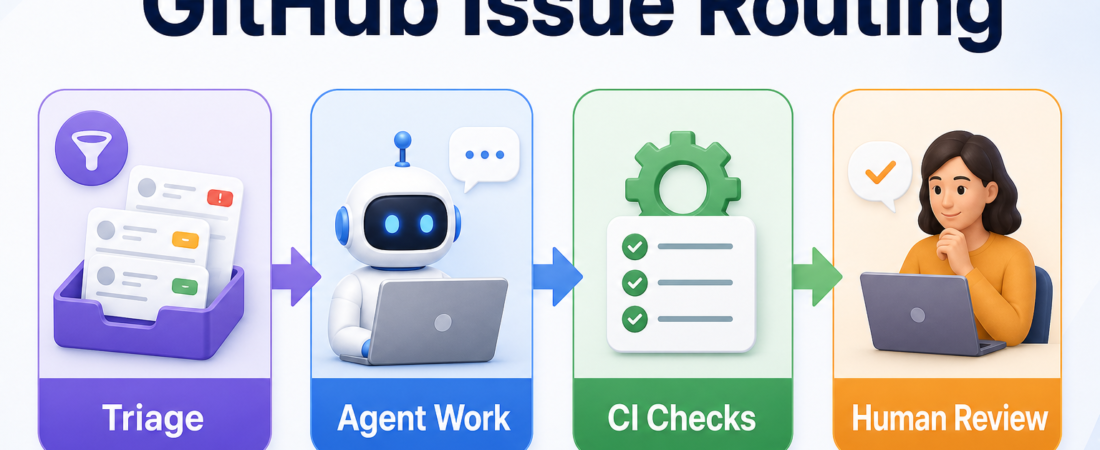
GitHub issues are a useful doorway into agent work because they already hold intent, context, discussion, labels, and acceptance notes. The risk is that teams treat the issue as a blank permission slip: an agent picks up a vague ticket, changes too much, and leaves reviewers to reverse-engineer what happened. A better route keeps the issue as the control surface. The agent can triage, draft a plan, prepare a branch, run checks, and respond to review comments, but the team keeps ownership of scope, CI evidence, and merge decisions.
| Route point | Agent can do | Human keeps |
|---|---|---|
| Triage | Summarize evidence, propose labels, find duplicates | Priority, ownership, and whether the issue is ready |
| Implementation | Create a bounded branch and explain the patch | Scope limits and architectural judgment |
| Review | Run CI checks and address specific comments | Approval, release timing, and merge control |
GitHub’s own workflow separates issues, pull requests, and Actions: issues track ideas and work, pull requests review changes, and Actions automate checks. Preserve that separation when agents join the loop. The issue describes the problem, the pull request shows the diff, CI provides repeatable evidence, and merge remains a human decision.
Who this is for
This workflow is for maintainers, engineering managers, and small platform teams that want agents to help with GitHub-backed work without handing over the whole software delivery lane. It fits repos where issues already drive planning, PR review is the normal quality gate, and CI checks are meaningful enough to block unsafe changes. It is also useful for open source maintainers who want help triaging incoming work while avoiding noisy labels, premature assignments, or agent-written pull requests that ignore project norms.
It is less useful when the repository has no issue hygiene. If tickets are one-line wishes, missing reproduction details, or mixed with private customer context, clean intake first. A good route needs a clear issue body, a narrow outcome, and an explicit place where a human can say stop.
Starter workflow
Start with issue readiness. Before an agent touches code, have it read the issue body, linked discussion, labels, and recent comments. The first output should not be a patch. It should be a short readiness note: what the issue asks for, what evidence is missing, which files or systems may be involved, and what counts as done. If the agent cannot identify a testable outcome, route the issue back to triage instead of implementation.
Next, constrain the work unit. Give the agent one issue, one branch, and one expected pull request. The prompt should name the issue, quote the acceptance criteria, and state what is out of scope. If the agent finds a broader refactor or policy question, it should note that on the PR rather than expanding the change silently.
Then require evidence in the pull request. A useful agent PR explains the problem, summarizes changed files, lists tests or checks run, and calls out anything it could not verify. Keep the evidence in the PR, not only in a chat transcript.
After that, let CI do the boring work. GitHub Actions can run tests, linters, build jobs, and release checks tied to repository events. Agents can inspect failing checks and propose fixes, but they should not reinterpret a failing required check as optional.
Finally, route review comments narrowly. Once humans review the PR, the agent should answer specific unresolved comments, not rewrite the whole patch. Ask it to quote the comment, state the intended change, and keep unrelated edits out.
Recommended ASE skills
Triage GitHub issues with body-first evidence checks is the right first stop when the queue itself is messy. Use it to separate ready work from reports that need reproduction steps, duplicate checks, or owner judgment.
Turn GitHub issues into reviewed code changes with SWE-agent fits the implementation lane once the issue is narrow enough. Its value is not that it removes review; it gives the agent a bounded route from issue to code change.
Inspect failing GitHub Actions checks and plan fixes with gh-fix-ci belongs after a branch or PR exists. It keeps the agent focused on real CI evidence rather than guessing from a red status badge.
Address GitHub PR review comments with gh-address-comments is useful late in the loop, when a reviewer has already left concrete feedback and the agent needs to make a targeted follow-up change.
Turn notes, logs, and screenshots into structured GitHub issues helps upstream of triage. Use it when the raw signal is a support note, log excerpt, or screenshot and you need a cleaner issue before assigning work.
What to watch
Watch for permission drift. A skill that can label issues is not automatically allowed to close them, assign owners, trigger deployments, or merge branches. Keep write permissions separate from read and analysis permissions.
Watch for hidden product judgment. Agents can summarize tradeoffs, but they do not own priority, roadmap fit, compatibility promises, or release timing. If an issue asks for behavior that affects users, the agent can prepare options and evidence. A person still needs to choose the product answer.
Watch for review fatigue. If agent PRs are consistently too large, too vague, or too hard to test, shrink the issue scope and require better readiness checks before reviewers spend time on the diff.
FAQ
Should agents label and close GitHub issues automatically?
They can propose labels and closure reasons, but automatic closure should be rare. Closing an issue changes the project’s public record and can frustrate contributors when the agent misunderstood the report. Start with suggestions, then grant write actions only where the policy is boring and reversible.
Can an agent open pull requests from issues?
Yes, when the issue is ready, scoped, and testable. The safer pattern is issue to branch to pull request, with the PR containing a clear summary, test evidence, and unresolved questions. Avoid letting the agent combine multiple issues unless a maintainer explicitly grouped them.
What GitHub docs should operators anchor on?
Use the official docs for GitHub Issues, pull requests, and GitHub Actions. Those docs define the collaboration surfaces that the agent should respect: issue discussion, code review, and automated checks.
What is the simplest rollout?
Begin with read-only issue triage for one repository. After that works, allow agent-created draft PRs for narrow issues. Add CI failure investigation next. Only then consider letting agents make targeted review-comment fixes on active branches.