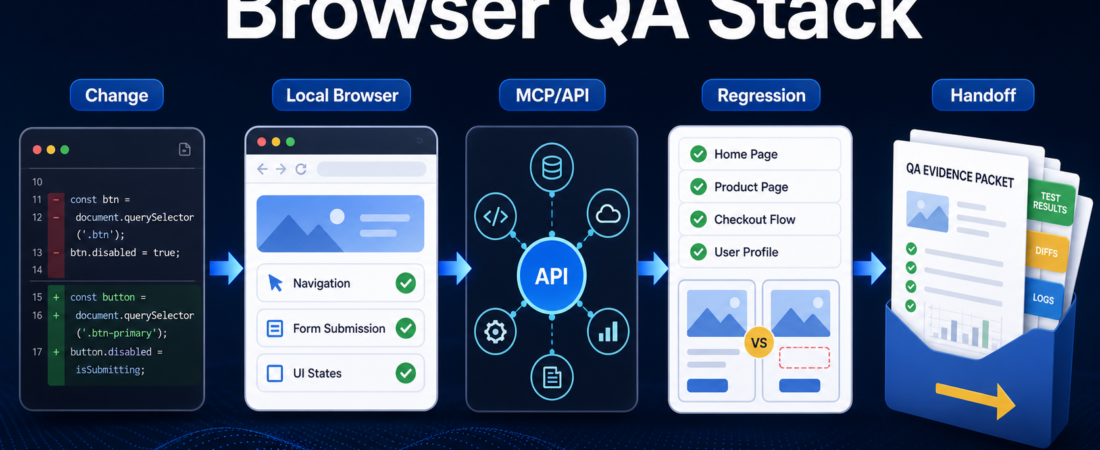
A Browser QA Stack for Agent-Written Web Changes
Agent-written web changes need a QA path that is fast enough to run during implementation and concrete enough for a human reviewer to trust. The browser stack should not be a vague request to “test the site.” It should turn a code diff into observed browser behavior, API evidence, repeatable checks, and a short handoff packet that explains what passed, what failed, and what still needs judgment.
| Layer | Question | Evidence to keep |
|---|---|---|
| Local browser | Does the changed screen actually work? | Steps, screenshots, console output |
| MCP/API | Are browser flows and service boundaries both covered? | Requests, responses, fixtures |
| Regression | Can the check be repeated before release? | Stable script, failure notes, reviewer handoff |
In Short
A useful browser QA stack has four jobs. First, it opens the changed app the way a user would. Second, it records enough evidence for a reviewer to understand the result. Third, it separates UI behavior from API or data problems. Fourth, it gives the coding agent a precise repair loop when something breaks.
Playwright is a good center of gravity because its official project covers browser automation, assertions, traces, screenshots, and test running across major browser engines. The newer MCP-style routes can make those browser actions available to agents without forcing every agent to invent its own browsing protocol. That does not remove the need for human review. It just gives the reviewer better artifacts.
Who this is for
This workflow is for teams that already let agents edit frontend code, CMS templates, admin screens, docs sites, internal tools, or customer-facing web apps. It fits small teams especially well because the same person may be asking for the change, reviewing the code, and deciding whether the result is safe to ship.
It is also useful when a pull request looks small but affects interaction: a disabled submit button, changed copy in a checkout step, a new dashboard filter, an auth redirect, a consent modal, or a form validation rule. Static review can catch obvious mistakes, but it will not prove that a real browser can load the app, click through the path, and preserve the expected state.
Starter workflow
Start with the changed surface, not the whole product. Ask the coding agent to name the pages, routes, components, and API calls it believes were affected. If it cannot do that, make it produce a smaller implementation note before browser QA begins.
For fast local checks, use Drive token-efficient browser testing from coding agents with Playwright CLI. This is the first layer when the agent needs to open a page, inspect the DOM, click through a flow, and capture screenshots without dumping an entire browser session into the conversation. Keep the steps short: load the route, perform the user action, inspect the visible result, and record console or network errors.
Next, add a supervised bridge with Run browser and API automation through the Playwright MCP server. Use this when the agent needs a more structured way to call browser and API automation from an MCP-capable environment. The value is not “more autonomy.” The value is that browser actions, API checks, and captured outputs can follow a common protocol.
When a failure appears, route it through Test agent-written web changes in a real browser and hand failures back for repair with Expect. The repair loop should include the failing step, the expected behavior, the observed behavior, and one artifact such as a screenshot, trace, log, or HTML snippet. “It failed” is not enough for an agent or a human.
For local apps that need a dev server, bring in Verify local web apps with Playwright scripts and managed dev servers. This is the layer that prevents a common false positive: a test plan that assumes the app is running but never proves the server became reachable. A managed server check should record the command, port, readiness URL, and shutdown behavior.
Finally, reserve Run AI browser regression checks with Playwright and multi-model verification through Passmark for repeatable regression coverage. Use it after you have a stable flow worth preserving, not as the first exploratory pass. Regression checks are most useful when the expected behavior is already clear.
Recommended ASE skills
- Playwright CLI for coding agents: best first pass for changed screens and concise evidence capture.
- Playwright MCP server: useful when browser and API checks need to sit behind a shared agent protocol.
- Expect browser repair loop: turns observed failures into concrete repair instructions.
- Managed local web app verification: proves the dev server, readiness check, and browser script all ran together.
- Passmark browser regression checks: keeps important user flows repeatable once the expected behavior is stable.
What to watch
Do not turn browser QA into a screenshot contest. Screenshots are useful, but they are not a substitute for assertions, route checks, API responses, accessibility basics, and reviewer judgment. A pretty page can still submit the wrong payload or hide a broken error state.
Be careful with authenticated flows, payment paths, destructive admin actions, and third-party services. Use staging data, test accounts, and explicit allowlists. GitHub’s code security docs are a useful reminder that automated checks should feed review, not replace it. The NIST AI Risk Management Framework makes the same general point in broader language: know the context, measure risk, manage it, and keep governance visible.
Also watch for brittle selectors. A browser test that clicks the third button in a panel may pass today and fail for the wrong reason tomorrow. Prefer user-facing labels, roles, stable test IDs where appropriate, and short traces that show what the browser actually saw.
FAQ
Should every agent-written web change get a full regression suite?
No. Small changes need a bounded browser pass and a clean handoff. Save full regression work for flows that are important, repeated, or risky enough to justify maintenance.
When should API checks be part of browser QA?
Add them when the UI depends on server state, auth, forms, search, checkout, or saved records. A browser check can prove the user path; an API check can explain whether the backend boundary behaved as expected.
What is the minimum evidence packet?
Keep the route, test account or fixture notes, commands run, assertions checked, failures found, and links to screenshots or traces. The packet should be short enough for a reviewer to read before deciding whether the change can move forward.
Official references: Playwright documentation and Microsoft Playwright MCP.