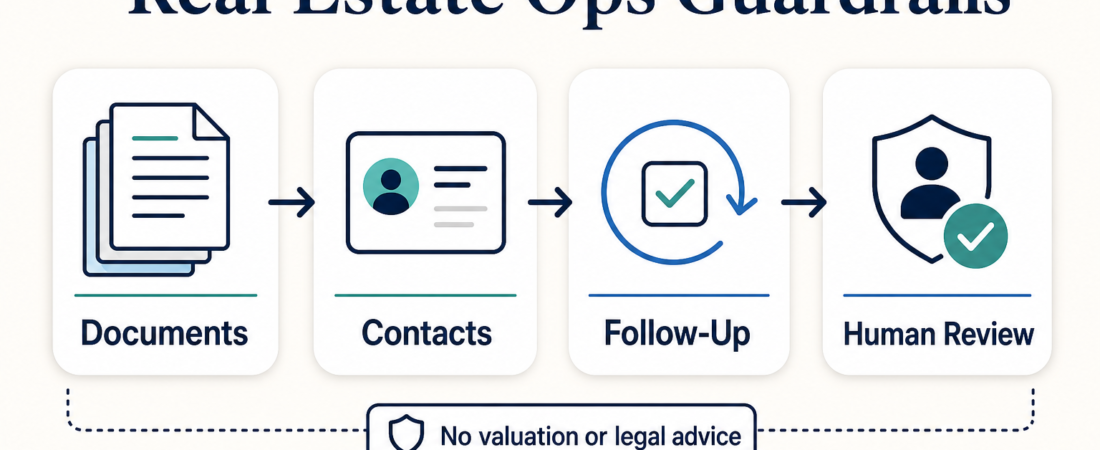
Real Estate Ops Without Overclaiming: Documents, Contacts, and Follow-Up
Real estate teams do not need an agent that pretends to be a broker, appraiser, attorney, or MLS oracle. They need help with the operational drag around transactions: collecting paperwork, extracting fields from PDFs, keeping contact context current, preparing follow-up drafts, and making sure a person reviews anything that affects a client, contract, listing, or deadline.
That is the right shape for real estate ops AI: assistive, evidence-oriented, and careful about boundaries. The useful work happens before judgment. Agents can turn messy inputs into reviewable packets, but they should not decide price, give legal advice, make buyer or seller recommendations, or change live listings without approval.
| Ops area | Use agents for | Keep human review on |
|---|---|---|
| Documents | OCR, field extraction, packet assembly | Contract meaning, missing clauses, legal interpretation |
| Contacts | CRM cleanup, notes, source-backed enrichment | Client segmentation, sensitive relationship decisions |
| Follow-up | Draft reminders, task lists, status summaries | Promises, negotiation language, deadline commitments |
| Listings | Formatting checks, image/text QA, change summaries | Pricing, compliance, publication, claims about property condition |
In Short
The best real estate operations workflow starts with boring reliability: documents in, structured facts out, contact records updated, follow-up drafted, and a clear review checkpoint before anything goes to a client or public listing surface.
Use ASE skills as building blocks, not as autonomous deal operators. A document parser can help extract names, addresses, dates, and tables. A signing tool can route forms. A CRM skill can synchronize contact context. A support or drafting skill can prepare a follow-up note. The operator still owns the judgment.
Who this is for
This guide is for real estate operations leads, transaction coordinators, brokerage admins, proptech teams, and small agencies trying to reduce paperwork drag without crossing into bad automation. It also fits teams evaluating whether a real estate workflow belongs in production at all.
It is not for teams trying to automate valuation, replace licensed professionals, scrape restricted listing systems, or publish property claims without review. Those jobs need policy, permissions, and accountable humans before they need another skill.
Starter workflow
Start with a four-step path that produces a review packet instead of an unsupervised action.
1. Collect and normalize the file set. Put purchase agreements, disclosures, inspection reports, invoices, IDs, forms, email attachments, and notes into a named folder per transaction. Convert scans into searchable text with OCRmyPDF Searchable PDF OCR Pipeline when the source is a scanned PDF. For mixed office documents and exports, use a conversion path like MarkItDown Document-to-Markdown Converter by Microsoft so the agent has text it can cite.
2. Extract only operational facts. Ask for fields such as party names, property address, inspection date, escrow deadline, document type, signature status, and missing attachments. Avoid asking the agent to decide whether a clause is acceptable or whether a disclosure is legally sufficient. For higher-volume document intake, compare managed parsing with LlamaCloud document parsing pipelines, local extraction with Docling Document Parsing and Conversion Toolkit, or OCR-to-markdown work with Zerox OCR-ready Markdown extraction.
3. Route forms and signatures with visible status. Use signing tools for packet routing, not legal conclusions. DocuSeal Document Signing and PDF Forms and Documenso Open Source Document Signing are useful when the job is to prepare forms, track signature completion, and record what still needs attention.
4. Update contact context and draft follow-up. Once the packet has source-backed facts, sync the operational context into the system of record. For CRM work, HubSpot CRM Contact Enrichment Pipeline, Salesforce CRM Sync Agent, or Twenty Open Source CRM can support contact cleanup and account context. Draft follow-up as pending text with citations to the packet: what changed, what is missing, what needs review, and who should respond.
Recommended ASE skills
For scanned transaction files, start with OCRmyPDF. For mixed document conversion, use MarkItDown. For managed parsing, evaluate LlamaCloud. For local parsing and conversion, look at Docling. For OCR-heavy extraction, use Zerox.
For signature routing, compare DocuSeal and Documenso. For CRM context, use HubSpot enrichment, Salesforce sync, or Twenty depending on where the team already works.
For broader context, read the earlier ASE guides on real estate workflow skills, the real estate operations stack, and turning PDFs into decision packets.
What to watch
The biggest risk is category drift. A workflow that starts as document cleanup can quietly become legal review. A contact update can turn into client prioritization. A listing QA pass can become pricing advice. Put those boundaries in the prompt, in the runbook, and in the review checklist.
Watch source quality too. Every extracted fact should point back to a file, page, field, email, or CRM record. If the agent cannot show the source, the output is a draft note, not an operational fact. That distinction matters when a deadline, signature, or client message depends on it.
Finally, separate private transaction data from general tooling tests. Use dummy files when evaluating a new parser or signing flow. Move to real records only after you know where data is processed, retained, logged, and reviewed.
FAQ
Can agents handle real estate paperwork end to end?
They can help assemble, extract, route, and summarize paperwork. They should not independently interpret contract terms, decide legal sufficiency, set price, or make client recommendations.
What is the safest first real estate ops use case?
Start with document inventory: collect the file set, identify missing items, extract dates and parties, and produce a review checklist. That creates value without letting the agent act on behalf of the team.
Should agents update live listings?
Only after human review. Agents can prepare change summaries, formatting checks, and draft copy, but publishing listing changes affects compliance, client expectations, and market-facing claims.
How many skills does a small team need?
Usually three to five: OCR or conversion, structured parsing, signing, CRM sync, and a drafting or checklist step. More tools add complexity unless the handoffs are clear.