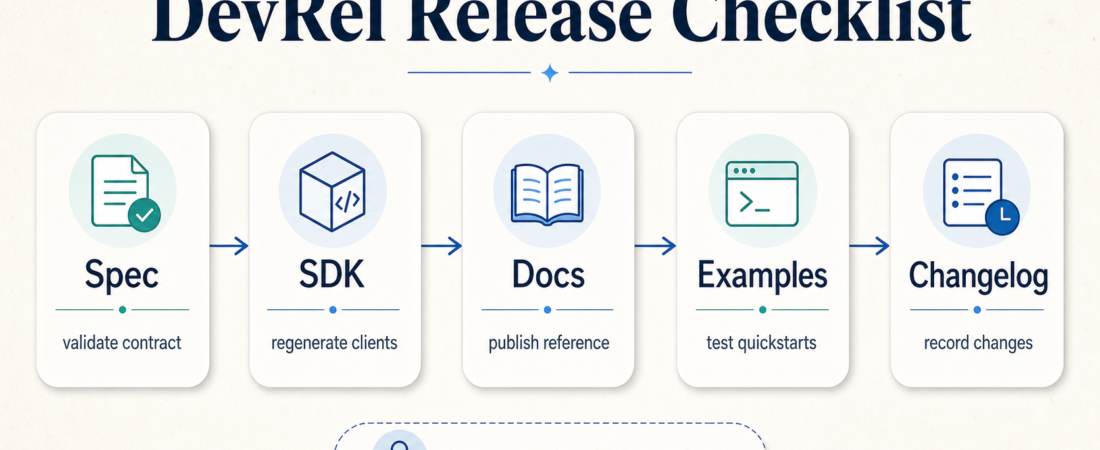
DevRel Release Checklist: Specs, SDKs, Docs, Examples, and Changelog
A developer relations release is not finished when the API ships. It is finished when a developer can understand the contract, install the client, follow the docs, run the example, and see what changed without asking the product team for context.
| Release surface | Operator check | Review owner |
|---|---|---|
| Spec | Contract validates and breaking changes are called out | API owner |
| SDKs | Clients regenerate from the accepted spec | Platform or DevEx |
| Docs | Reference pages match the released endpoints | DevRel |
| Examples | Quickstarts run from a clean environment | Developer advocate |
| Changelog | Migration notes explain what changed and who is affected | Release lead |
In Short
A practical DevRel release checklist should connect five surfaces: specs, SDKs, docs, examples, and changelog notes. If one is stale, developers feel it as a broken onboarding path even when the product code is technically correct. Treat the checklist as a review packet: validate the OpenAPI contract, regenerate client code, publish reference docs, run examples from scratch, and write migration notes before the announcement goes out.
ASE skills can help with the repeatable parts, especially spec validation, documentation generation, SDK regeneration, prose review, and contract testing. They should not replace human release judgment. The useful pattern is agent-assisted evidence, followed by explicit review.
Who this is for
This checklist is for DevRel, developer experience, API platform, and product engineering teams that publish APIs, SDKs, CLI tools, or integration docs. It is especially useful when the release involves more than one repo: an API implementation, an OpenAPI document, generated clients, docs content, examples, and a public changelog.
Small teams can use it as a lightweight preflight. Larger teams can turn it into a release issue template or CI-backed review packet. The point is not to add ceremony. The point is to catch the boring mismatches that create support tickets: an endpoint renamed in the spec but not the guide, an SDK generated from yesterday’s contract, an example that assumes an environment variable nobody documented, or a changelog that says “improved API behavior” without naming the affected users.
Starter workflow
Start with the API contract. If the release has an OpenAPI surface, validate it before touching docs or SDKs. A skill such as Redocly CLI OpenAPI Linter and Documentation Generator, Spectral OpenAPI and AsyncAPI Linter, or OpenAPI Specification Validator can help flag structural problems, missing descriptions, inconsistent parameters, and invalid schema references. Use the official OpenAPI Specification as the source of truth for what the document is supposed to mean.
Next, regenerate clients and check for drift. If your team uses generated TypeScript clients, Orval OpenAPI Client Regeneration Skill for Typed SDKs belongs in the packet. The review question is simple: did the SDK come from the accepted spec, and did the generated diff get reviewed by someone who understands the public API? For contract-level confidence, add a check such as Dredd contract tests from API descriptions before you call the release ready.
Then publish or update the reference layer. Scalar OpenAPI Reference and API Client Platform and Redoc OpenAPI Documentation Renderer fit different documentation preferences, but the operator check is the same: can a developer inspect the endpoint, parameters, auth shape, and response examples from the docs without switching to source code?
After that, run examples from a clean environment. This is where many releases fail quietly. Do not only read the quickstart. Clone it or copy it into a fresh directory, install dependencies, set only documented variables, and run the happy path. If the example needs seeded data, a demo account, or a feature flag, the docs should say so. If it takes more than a few minutes to reproduce, the changelog should not pretend the release is self-service.
Finish with the changelog. A good entry names the affected surface, the old behavior, the new behavior, the migration path, and the date. Use a prose linter such as proselint Prose Linting and Style Checker CLI for obvious clarity issues, but keep the final call human. Changelog quality is about accountability, not just grammar.
Recommended ASE skills
| Release job | ASE skill | Use it for |
|---|---|---|
| Spec validation | Spectral OpenAPI and AsyncAPI Linter | Linting OpenAPI and AsyncAPI documents before downstream docs or SDK work. |
| Reference docs | Redocly CLI OpenAPI Linter and Documentation Generator | Bundling, checking, and producing reference material from API descriptions. |
| Interactive docs | Scalar OpenAPI Reference and API Client Platform | Turning accepted API specs into developer-facing reference experiences. |
| SDK regeneration | Orval OpenAPI Client Regeneration Skill for Typed SDKs | Regenerating typed clients from the current OpenAPI contract. |
| Contract confidence | Dredd contract tests from API descriptions | Checking live endpoints against the documented contract before integrations break. |
What to watch
Do not let generated artifacts outrun review. A generated SDK can still expose confusing names, rough ergonomics, or accidental breaking changes. A generated reference page can still be incomplete if the source spec lacks examples. An agent can summarize a changelog, but it cannot know which customer segment will be surprised unless the release owner provides that context.
Also watch for false confidence from green checks. Spec validation proves the document is structurally acceptable. It does not prove the implementation matches production behavior. SDK generation proves the client can be produced. It does not prove the quickstart teaches the right thing. Keep the checklist tied to evidence: validation output, generated diffs, live contract test results, clean-room example runs, and reviewed migration notes.
FAQ
Should every DevRel release require all five checks?
No. Use the full checklist when the release changes a public API, SDK, integration, or onboarding path. For small docs-only edits, the relevant checks may be docs review, example verification, and changelog clarity.
Where should the checklist live?
Put it where release work already happens: a GitHub issue template, release PR checklist, Linear template, or internal launch doc. The important part is that each check has an owner and a link to evidence.
Can an agent publish the docs automatically after these checks pass?
It can help prepare the release, but publishing should still follow your team’s normal approval path. For public developer surfaces, a human should review the final contract, examples, and migration language.
What is the fastest way to start?
Begin with spec validation and clean-room example runs. Those two checks catch a large share of avoidable developer frustration before the announcement goes out.