ASE Weekly Changelog: What Operators Can Try Before the Weekend
This week on Agent Skill Exchange, the useful pattern is not “add more tools.” It is choosing a small route, proving it works, and writing down the boundary before the agent touches production work. If you have a quiet hour before the weekend, use it to test one of the paths below with a real task and a harmless fixture.
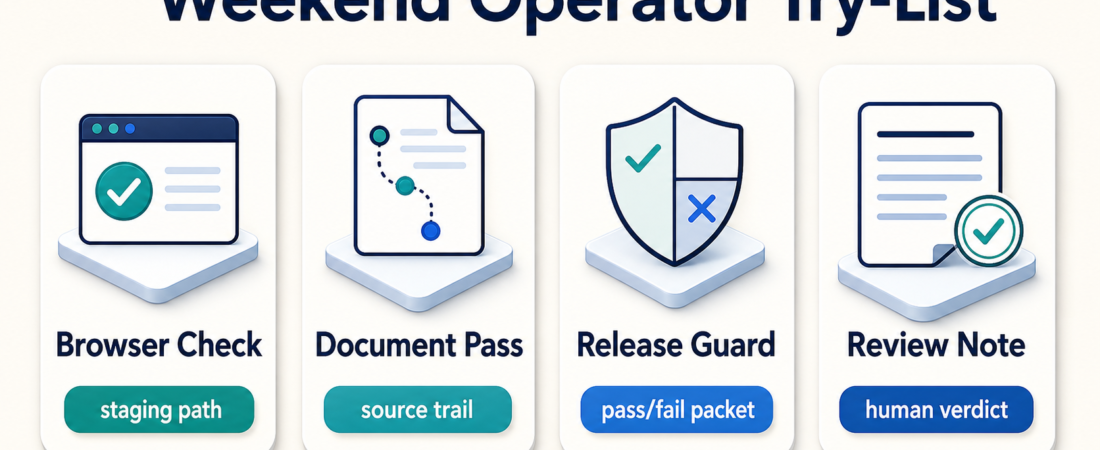
| Try-list | Good first test | Stop if |
|---|---|---|
| Browser check | Run one repeatable login or checkout path | The agent needs private credentials without a test account |
| Document pass | Convert one source file into a reviewable summary | The source cannot be traced back from the answer |
| Release guard | Check docs, links, and smoke tests before deploy | The result becomes a vague launch opinion |
In Short
The best operator move this week is to pick one narrow automation lane and make it boringly repeatable. Browser automation is useful when you can point it at a stable test path. Document skills are useful when they preserve source evidence. Release-check skills are useful when they produce a pass/fail packet instead of a long commentary thread.
Start with low-risk work: public pages, sample files, staging environments, and internal docs that do not contain secrets. A skill that performs well there earns a broader trial. A skill that needs constant prompting, hand-holding, or cleanup should stay in evaluation.
Who this is for
This update is for operators, founders, DevRel leads, support managers, and technical PMs who want to use agent skills without turning every experiment into a platform project. You do not need a full agent program to learn something useful this week. You need one bounded task, one success condition, and one place to record what happened.
It is also for teams that already have too many “AI ideas” and not enough operational proof. The question is not whether a browser agent, document parser, or release assistant sounds impressive. The question is whether it can remove a recurring piece of work while leaving a clear trail for a human reviewer.
Starter workflow
1. Pick a task with a visible finish line. Good candidates include checking whether a marketing page still loads, turning one PDF into markdown, summarizing a known research folder, or validating that release notes link to the right docs. Avoid tasks where success is purely subjective.
2. Choose the skill by job, not novelty. For browser tasks, compare options like Browser Use Agentic Browser Control, Stagehand Browser Automation SDK, and Checkly CLI Monitoring as Code. Browser Use and Stagehand fit exploratory or scripted browser control. Checkly fits repeatable monitoring and smoke checks.
3. Keep document work source-first. If you are testing intake, use a file where you already know the expected answer. MarkItDown Document-to-Markdown Converter is a practical first stop for turning common files into markdown. Docling Document Conversion and Extraction Toolkit is a stronger fit when layout and extraction quality matter. Do not accept a polished summary unless the agent can point back to the input.
4. Add one release guard. Teams shipping docs, SDKs, or examples should try one pre-release check instead of a full launch assistant. Spectral OpenAPI and AsyncAPI Linter can catch contract issues. Vale Prose Linter for Technical Documentation can enforce docs quality. Danger JS Pull Request Automation Toolkit can turn review rules into visible pull request feedback.
5. Write down the result. Capture the input, the skill used, the command or prompt, the output, and the human verdict. A useful agent trial creates a repeatable operating note. A vague demo creates another meeting.
Recommended ASE skills
For a weekend-sized browser test, start with Browser Use when the task needs flexible navigation, Stagehand when you want a developer-friendly browser automation layer, and Checkly when the check should become recurring monitoring.
For content and document intake, test MarkItDown on simple conversions and Docling on richer files. If the work starts with public web research, Crawl4AI Open-Source Web Crawling and Markdown Extraction is worth a look because it is built around crawler output that agents can actually read.
For release readiness, pair Spectral with Vale and Danger JS. That gives you one check for API shape, one for documentation quality, and one for review visibility.
What to watch
Watch for skills that hide uncertainty. The output should say what it checked, what it skipped, and what evidence supports the result. “Looks good” is not enough for browser QA, document intake, or release readiness.
Also watch for accidental scope creep. A browser skill should not quietly become a credential manager. A document skill should not become an authority on legal, medical, or financial meaning. A release checker should not decide whether the business should ship. Keep the agent close to collection, transformation, comparison, and verification. Keep judgment with the team.
Finally, check links before you operationalize anything. Internal skill pages should be live, source links should make sense, and the skill description should match the job you are assigning. If the page is thin or the upstream project looks stale, treat the result as a research note rather than a production-ready route.
FAQ
Should we test more than one skill at a time?
Only if the task is small and the comparison is clear. For most teams, one task across two candidate skills is enough to learn which direction is worth more time.
What is the safest first weekend test?
A public-page browser check or a document conversion on a non-sensitive sample file. Both produce visible outputs and make failure easy to inspect.
When should a trial become a repeatable process?
When the same input type succeeds more than once, the output includes evidence, and a human reviewer can explain exactly what the skill is allowed to do.
What should we avoid?
Avoid giving agents broad production access just because a demo worked once. Narrow permissions, test fixtures, and human review make the difference between a useful skill and a risky shortcut.