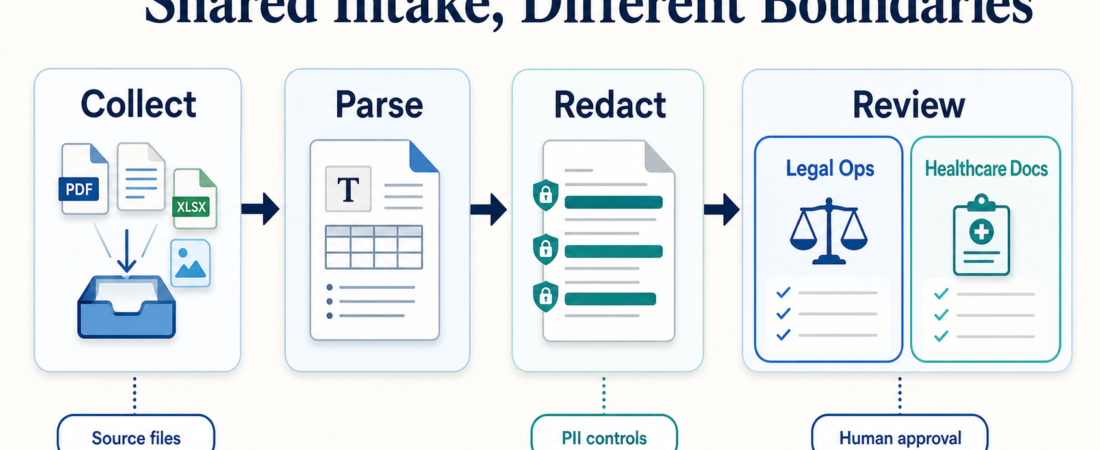
Legal and Healthcare Document Intake: Shared Tools, Different Boundaries
Legal and healthcare document work often starts with the same messy inputs: scanned PDFs, intake forms, email attachments, signed documents, tables, images, and hand-entered notes. The useful agent workflow is a tight intake lane: collect the source, make it readable, extract the parts that matter, redact what should not travel, and route the result to human review.
That is why several of the same document skills can fit both Legal Ops & Compliance and Healthcare Documentation & Intake. The difference is not usually the parser. It is the boundary around what the output is allowed to claim, who reviews it, and how sensitive data moves through the workflow.
| Intake step | Shared document skill pattern | Legal boundary | Healthcare boundary |
|---|---|---|---|
| Collect | Preserve original files and source context | Keep matter, contract, signer, and audit context attached | Keep patient/member context protected and minimum necessary |
| Parse | OCR, layout parsing, table extraction, markdown conversion | Prepare review packets, not legal conclusions | Prepare documentation support, not diagnosis or treatment advice |
| Redact | PII/PHI detection, removal, and share-safe copies | Protect privileged and confidential material | Protect health identifiers and access-controlled records |
| Review | Human approval with cited source snippets | Attorney, compliance, or ops review before action | Clinical, compliance, or admin review before action |
In Short
Use the same document intake primitives for both legal and healthcare: OCR, parsing, redaction, source citation, and review routing. Then change the operating rules around the output.
For legal work, the agent should help assemble evidence: clauses, dates, names, signatures, document versions, missing fields, and review notes. It should not approve a contract, interpret obligations as legal advice, or make privilege decisions without review.
For healthcare documentation, the agent should help with intake and administrative preparation: reading forms, extracting fields, organizing attachments, and preparing records for review. It should not make clinical claims, infer diagnoses, or treat an extracted field as a medical decision. If healthcare boundaries are involved, design around minimum necessary access and HIPAA-aware handling; HHS has a plain-language overview of the HIPAA Privacy Rule.
Who this is for
This post is for operations teams that already handle sensitive documents and want agent help without turning the agent into an unreviewed decision maker.
In legal ops, that might mean contract intake, signed document routing, matter file cleanup, compliance evidence collection, or archive search. In healthcare documentation, it might mean intake packet preparation, OCR for scanned forms, literature-support workflows, admin record normalization, or structured extraction from non-diagnostic paperwork.
The common mistake is to evaluate only extraction accuracy. Sensitive document intake also needs provenance, access control, redaction, escalation, and review ownership. A parser is only one piece of the operating model.
Starter workflow
A practical shared workflow has five steps.
1. Keep the original file attached. The agent should never replace the source document with a summary. Store or reference the original PDF, scan, or email attachment so reviewers can inspect the evidence.
2. Convert the document into agent-readable text. For scanned or image-heavy files, use OCR-first tools such as Zerox, Tesseract OCR, or related document conversion skills. For managed parsing pipelines, LlamaCloud Services can fit teams that need a more structured pipeline around ingestion and extraction.
3. Extract fields with source anchors. Dates, parties, form fields, tables, codes, signer names, and sections should come with page numbers or quoted snippets. Reviewers need to see whether a field came from a contract, intake form, scanned note, or attached record.
4. Redact before sharing or indexing. Legal and healthcare teams both need strict rules for what can leave the intake lane. Nutrient Agent Skill is useful when OCR, redaction, and signing workflows sit close together. For text-level PII cleanup, scrubadub gives teams a narrower primitive.
5. Route a review packet, not a final answer. The output should make the reviewer faster: source file, extracted fields, redactions applied, uncertainties, and next queue. The final decision still belongs to the responsible owner.
Recommended ASE skills
Start with the document shape, then choose the skill.
If the source files are scans, screenshots, or image-heavy PDFs, start with Extract OCR-ready Markdown from documents with Zerox or Tesseract OCR Engine for Image-to-Text Workflows.
If the team needs a managed parsing lane, look at Build managed document parsing pipelines with LlamaCloud Services.
If the source is already a digital PDF but needs richer structure, Docling Graph can help when the downstream task benefits from validated relationships rather than plain text alone.
If redaction is part of the process, use Nutrient Agent Skill for document-level redaction and signing-adjacent workflows, or scrubadub for text-level PII cleanup before sharing extracted content with another system.
For broader collection browsing, compare the document tools under Legal Ops & Compliance and Healthcare Documentation & Intake. The overlap is intentional: ASE maps skills by practical workflow fit, not by pretending that one tool has the same risk profile in every domain.
What to watch
Do not let summaries become records. A summary is a navigation aid. It is not the source of truth. Keep source files and extraction evidence close to the output.
Separate parsing from judgment. OCR and parsing can be automated more safely than legal interpretation or healthcare decision-making. Treat extraction as preparation for review.
Be precise about sensitive data movement. Before indexing documents into a search system or sending snippets to another service, decide whether redaction is required, who can access the processed text, and what should be logged.
Watch for domain drift. A generic parser may handle both a contract and an intake form, but the next action is different. Legal review, compliance review, healthcare administration, and clinical review are not interchangeable queues.
Prefer small, inspectable steps. The dependable workflow is a chain of clear artifacts: original file, parsed text, extracted fields, redacted copy, review packet, and decision owner.
FAQ
Can the same OCR skill be used for legal and healthcare documents?
Yes, as long as the surrounding workflow changes. The OCR step may be the same, but access control, redaction, review ownership, and claims boundaries should be different.
Should healthcare intake skills be described as clinical AI?
No. For ASE-style operator workflows, keep the positioning to documentation, intake, extraction, routing, and review support unless a tool is explicitly built and approved for clinical use. Avoid diagnosis, treatment, or autonomous care claims.
What is the safest first automation?
Start with read-only document preparation: OCR, conversion to markdown, field extraction with page references, and a review packet. Delay write-back, sending, approval, or record mutation until the review process is proven.
When should redaction happen?
Before extracted text is shared outside the original access boundary, indexed into a broader search system, or used in a downstream workflow that does not need raw identifiers. Redaction should be explicit and logged.
How do I choose between Zerox, LlamaCloud, Tesseract, and Docling Graph?
Use Zerox or Tesseract when readability is the first problem, LlamaCloud for a managed parsing pipeline, and Docling Graph when relationships between document elements matter.