Why “Blank Is Better Than Wrong” Is the Right Rule for Agent Skill Metadata
Agent skill catalogs are only useful when builders can trust what they see. A skill page may look complete when every author, tool, framework, source URL, install command, and capability field is filled in, but completeness is not the same as accuracy. In a marketplace, wrong metadata is not cosmetic debt. It sends developers to the wrong repository, inflates trust signals, confuses framework support, and teaches agents to make decisions from bad evidence.
That is why ASE uses a simple rule for catalog quality: blank is better than wrong. If a field cannot be backed by the skill source, the live repository, the package registry, or another durable reference, the honest answer is an empty field. A blank tells the reader, the maintainer, and the agent that the catalog has not verified the value yet. A guessed value pretends the work is done and makes the mistake harder to find later.
| Field state | Catalog action | User impact |
|---|---|---|
| Source-backed | Publish the value and link the evidence | Readers can verify and reuse it |
| Likely but unconfirmed | Leave blank until verified | No false confidence is introduced |
| Conflicting evidence | Prefer the canonical source or pause | Bad joins do not spread across the catalog |
| Generated guess | Reject it | The marketplace stays auditable |
The hidden cost of “complete” metadata
Skill metadata has a quiet influence on almost every marketplace workflow. It powers search filters, category pages, trust labels, related-skill recommendations, installation guidance, and the internal checks that decide whether a skill deserves to be promoted. When metadata is accurate, it reduces friction. A developer looking for a JSON validation tool can move quickly from a catalog card to Validate JSON data and config files against schemas with ajv-cli, compare it with JSON Schema CLI validation workflows, and understand which one fits the job.
When metadata is wrong, the same surfaces become traps. A source URL that points to a similarly named repository can make a skill look maintained when it is not. A guessed author can give credit to the wrong maintainer. A generic tool field can cause an agent to reach for the wrong CLI. A category tag added because the title “sounds like docs” can pollute industry collections and make real documentation skills harder to find.
For humans, these errors waste time. For agents, they are more dangerous because metadata often becomes planning context. If a coding agent reads that a skill supports a framework, uses a package manager, or exposes a command, it may build its next steps around that claim. Bad catalog data becomes bad automation.
Provenance is a product feature
The strongest skill pages make their provenance obvious. They connect the marketplace listing to the canonical source, and they avoid treating title similarity as proof. This matters because modern agent ecosystems are full of near-duplicates: forks, wrappers, unofficial clients, example projects, renamed packages, and generated repos that borrow language from popular tools. A catalog that joins records by vibes will eventually merge the wrong things.
Good provenance asks boring, practical questions. Does the repository name match the project being described? Does the package metadata point to the same upstream? Does the documentation mention the command or API the skill claims to use? Does the source link actually resolve? If the answer is no, or even “not yet,” the field should stay blank.
This is the same discipline behind reliable workflow skills. A skill like Bundle and validate OpenAPI files into one publishable spec with swagger-cli is valuable because it pushes toward deterministic validation instead of trusting prose. A catalog needs the same mindset. The page should show what has been verified, not what a model could plausibly infer from a name.
Blanks are not failures
A blank field can feel unsatisfying, especially on a public marketplace page. It looks unfinished. It may reduce the polish of a card. It can make a dataset appear less mature in a spreadsheet. But in a trust-sensitive catalog, blanks are useful because they preserve uncertainty in a visible form.
That visible uncertainty creates three advantages. First, it keeps the reader from relying on invented data. Second, it gives maintainers a clean queue of enrichment work: every blank is a field that can be researched later. Third, it prevents one bad guess from being copied into exports, GitHub mirrors, search indexes, summaries, and future articles.
The alternative is worse. Once synthetic metadata is published, it starts to look authoritative simply because it is present. Someone builds a filter around it. Someone links it in a roundup. Someone uses it as training context for a new skill. By the time the error is found, the catalog has to unwind a chain of downstream assumptions.
What should be source-backed?
Not every field needs the same level of proof, but the fields that shape user decisions should have a high bar. Source URL is the obvious one. It should point to the canonical repository, package, documentation page, or project home that directly supports the skill. Author and maintainer fields should come from the source, not from a quick web search. Tool names should match installed commands, SDKs, APIs, or services described by the source. Framework compatibility should reflect the actual skill format, not the model or agent mentioned in the README.
Install instructions deserve special care. A command copied from the wrong package is not a typo; it is an operational hazard. A careful catalog should treat installation commands the way a CI pipeline treats configuration. Validate syntax where possible, prefer upstream instructions, and avoid filling in a command just because many similar projects use one. Skills such as Pin CI workflow actions and images with Ratchet exist because supply-chain details matter. Skill metadata should respect the same principle.
Descriptions and taglines also need restraint. They should explain what the skill helps an agent do, but they should not claim support for tools, industries, or safety guarantees that are not present in the source. This is especially important for regulated or high-risk domains. The marketplace should say “supports document intake” when that is what the evidence shows, not “handles legal review” because the phrase sounds more impressive.
How to enrich without inventing
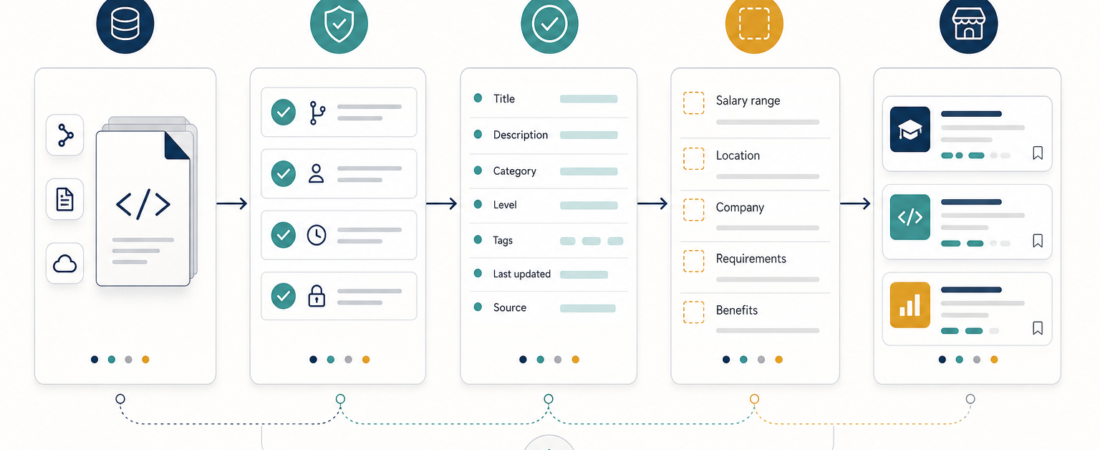
The practical workflow is simple: collect evidence first, transform second, publish last. Start with the canonical source. Read the README, package metadata, docs site, examples, and release files. Extract only the fields that are directly supported. If the source conflicts with a registry or mirror, prefer the canonical project or leave the field blank and mark it for review.
Then validate structure. JSON, YAML, Markdown frontmatter, OpenAPI specs, citation files, and package metadata all have tools that can catch malformed or inconsistent records. ASE skill pages can point builders toward concrete validators such as citation and CFF formatting workflows, REST API design review, and schema validation skills because the same habits apply to marketplace data. Parse structured sources when you can. Do not scrape prose when a package manifest or API schema has the value.
Finally, keep the enrichment path repeatable. A one-off guess is not maintainable. A source-backed extraction rule can be rerun, audited, and improved. If a field was left blank yesterday, a later enrichment sweep can fill it when the evidence becomes available. That is a healthy catalog lifecycle, not a flaw.
How this affects ranking and trust
Trust signals should reward evidence, not confidence theater. A skill with fewer fields but clean provenance is often safer to surface than a fully decorated listing assembled from assumptions. This is especially true when a marketplace uses stars, downloads, source links, trust tiers, and featured placements to help users decide what to try first.
ASE’s trust posture is intentionally conservative. The goal is not to make every listing look equally complete. The goal is to make each listing honest about what is known. That is the same philosophy behind the recent post on Skill of the Day, Featured Skills, and Trust Signals: promotion should be based on signals that can be explained, not on hidden decoration.
For marketplace operators, this changes the meaning of quality work. Quality is not only writing better descriptions. It is deleting bad joins. It is refusing to synthesize author names. It is checking that a GitHub source really belongs to the skill. It is accepting that a blank “tools” field may be the correct state until a source says otherwise.
A checklist for skill metadata
Before publishing or updating a skill listing, ask five questions. Can the source URL be opened and matched to the skill? Is every named tool present in the documentation, package metadata, examples, or install instructions? Are author and maintainer fields copied from a durable source rather than inferred? Are categories based on the workflow the skill actually supports? Would a user or agent make a worse decision if this field were wrong?
If a field fails that test, leave it blank. If the value seems likely but not proven, leave it blank. If two sources disagree and neither is clearly canonical, leave it blank and review later. The blank is a guardrail. It keeps uncertainty from hardening into misinformation.
Creators can help by making their own skill metadata easy to verify. Include a clear source link, a concise description of the workflow, explicit prerequisites, tested commands, and a note about what the skill does not do. A well-structured creator workflow, such as Agent Skill Creator, should make these boundaries easier to document from the start.
The mature catalog is the honest one
The temptation in any marketplace is to optimize for visible abundance: more tags, more fields, more badges, more polished cards. But an agent skill marketplace has a different responsibility. It is not just helping people browse software. It is feeding operational context to systems that may act on it.
That raises the bar. Metadata should be treated as part of the product, not as filler around the product. The right rule is conservative because the downstream cost of being wrong is higher than the cosmetic cost of being incomplete. Blank fields are invitations to verify. Wrong fields are liabilities disguised as confidence.
For ASE, “blank is better than wrong” is not a slogan about minimalism. It is a quality standard. It keeps provenance visible, protects users from false certainty, and gives the catalog a foundation that can improve without needing to unwind invented history. In agent skill metadata, honesty scales better than polish.