Skill of the Day, Featured Skills, and Trust Signals: How ASE Surfaces Better Skills
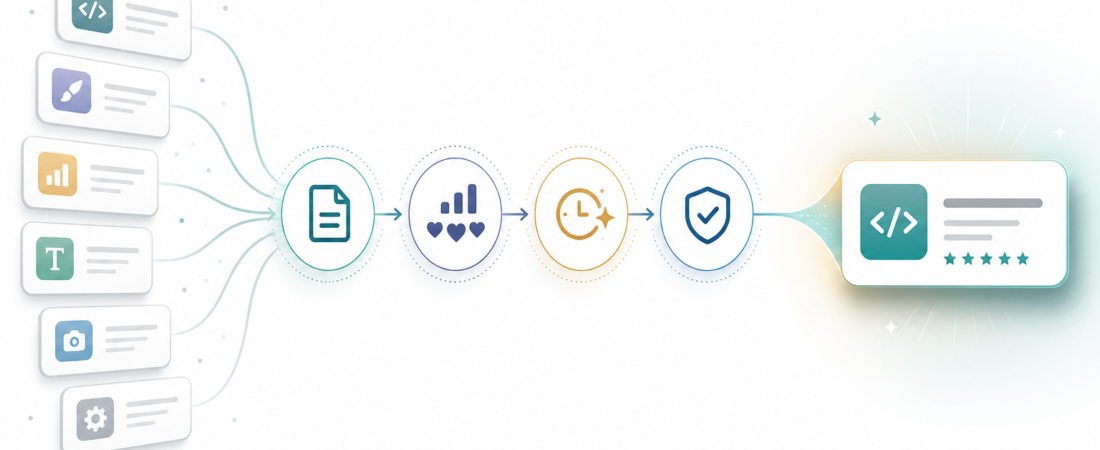
Agent Skill Exchange has two jobs that sometimes pull against each other. It needs to help people find useful agent skills quickly, and it needs to avoid pretending that every skill in a fast-moving catalog deserves the same confidence. That is why surfaces like Skill of the Day, featured skill blocks, recent-popular pools, and trust signals matter. They are not decoration. They are the marketplace’s way of saying, “start here, but still inspect the evidence.”
| Surface | Signal it should reward | What readers should do next |
|---|---|---|
| Skill of the Day | Fresh, useful, source-backed skill records | Open the skill page and verify fit |
| Featured Skills | High-signal workflows across categories | Compare adjacent tools before installing |
| Trust Signals | Provenance, stars, downloads, freshness, and boundaries | Prefer evidence over generic popularity |
A skill marketplace is easy to make noisy. New tools arrive every week. Repository names change. Package metadata is inconsistent. Some projects have polished READMEs but thin agent-specific workflows. Others are boring infrastructure tools that quietly become essential once an agent is responsible for a real deployment, support queue, or document workflow. A useful marketplace has to sort through all of that without flattening the catalog into a popularity contest.
ASE’s surfacing model starts from a simple principle: the best default recommendation is not always the biggest project. It is the skill that has enough evidence, a clear workflow, and a plausible reason to be useful right now. GitHub stars, package downloads, category placement, and freshness are signals. They are not verdicts. A high-star tool with vague skill metadata can still be a poor recommendation. A newer skill with strong source alignment and a precise operational use case can be a better starting point.
Why Skill of the Day Exists
Skill of the Day is a discovery shortcut. It gives the homepage and blog readers a rotating entry point into the catalog instead of asking them to browse hundreds of skills cold. The goal is not to crown a permanent winner. The goal is to surface one skill that is timely, understandable, and worth inspecting.
That distinction matters. A daily feature should be opinionated enough to reduce choice overload, but modest enough that readers still treat it as a starting point. If someone is exploring browser-based verification, a skill like Playwright Python Browser Automation Library for Cross-Browser Testing is useful because it maps to a concrete job: driving real browser checks across Chromium, Firefox, and WebKit. If a team is turning monitoring into repeatable release gates, Checkly CLI Monitoring as Code for API and Browser Checks is useful for a different reason: it lets checks live closer to code and deployment practice.
The surface should not imply those two skills are interchangeable. It should help readers ask the right next question: what workflow am I trying to improve? A browser testing skill, a monitoring skill, and a security scanning skill can all be “popular,” but they serve different moments in an agent workflow.
Featured Skills Should Represent Workflows, Not Just Brands
Featured skill blocks are most useful when they represent a set of jobs a real operator recognizes. For example, a deployment readiness surface might pair browser checks, API checks, security scans, dependency updates, and runtime observability. That kind of grouping is more useful than a random list of famous projects because it mirrors how teams actually work.
Consider a practical launch-readiness path. A team might use Renovate Automated Dependency Update Bot and CLI to keep dependency changes visible, Trivy Security Scanner for Containers and IaC to inspect images and infrastructure definitions, Checkly CLI to encode critical external checks, and SigNoz Open-Source Observability Platform to investigate traces, metrics, and logs after launch. None of those skills replaces engineering judgment. Together, they form a stronger release conversation.
That is the kind of featured surface ASE should reward: not “here are five tools with impressive names,” but “here are five skills that help an agent do a bounded piece of work with evidence.” When a featured block is organized around a workflow, users can decide whether they need the whole stack, one piece, or a safer manual process.
Trust Signals Need Source Alignment
Trust signals are only helpful if they point back to real evidence. Source alignment is the first layer. A skill page should connect to the correct upstream project, package, documentation, or repository. If the source is unclear, the marketplace should say less, not more. Blank metadata is better than invented confidence.
This is especially important for agent skills because the skill record is not just a directory listing. It becomes part of an operator’s decision process. A user deciding whether to install a WordPress automation skill, for example, needs to know whether the skill points to a real project and a maintained workflow. WP-CLI WordPress Command Line Interface is a clear case: the operational surface is well understood, the underlying tool is real, and the skill can be evaluated against a mature command-line workflow.
Source-backed stars and downloads are useful after that alignment exists. Stars can suggest community attention. Downloads can suggest operational adoption. Freshness can suggest whether the skill is still likely to match current APIs. But each signal is conditional. Stars attached to the wrong repository are worse than no stars. A download count for an adjacent package can mislead. A stale but stable infrastructure tool may still be safer than a fresh wrapper with no usage history.
Popularity Is a Filter, Not a Ranking Philosophy
Recent-popular pools help a marketplace avoid two bad defaults: only showing old incumbents, or only showing brand-new additions. A recency window gives newer skills a chance to appear, while popularity signals keep the surface from becoming arbitrary. The right balance depends on the category.
In observability, mature tools often deserve weight because operators care about reliability, integrations, and long-term maintenance. In AI evaluation or agent orchestration, newer projects can matter quickly because the workflow itself is changing. A surfacing system should be flexible enough to notice both patterns. LangSmith SDK for LLM Tracing and Evaluation and OpenMeter Usage Metering and Billing Platform sit in different operational contexts, but both become more useful when the catalog makes their actual use case clear instead of treating them as generic “AI tools.”
The practical rule is simple: popularity should open the door, not end the conversation. A reader should still see what the skill does, where the source comes from, what category it belongs to, and what kind of workflow it supports.
Good Surfacing Makes Boundaries Visible
The more powerful the skill, the more important its boundaries become. A skill that reads logs is different from one that changes infrastructure. A skill that drafts a support reply is different from one that sends it. A skill that extracts invoice fields is different from one that approves payment. Featured surfaces should preserve those distinctions.
This is where trust tiers and cautious category language help. They remind readers that a marketplace is not an authorization system. ASE can make discovery easier, point to source evidence, and group skills into useful workflows. It should not imply that a skill is safe for every environment or that installation is a substitute for review. The right next step is still local: inspect the skill, read its instructions, understand its permissions, and test it in a controlled setting.
What Better Discovery Looks Like
A better skill marketplace does not need to hide how it works. Readers should understand why a skill appears on the homepage, why a featured set exists, and which signals are being used. Transparency makes recommendations easier to trust because it exposes the limits of the system.
For ASE, that means daily and featured surfaces should keep moving toward four habits. First, show skills with clear source alignment. Second, prefer workflow relevance over generic fame. Third, use popularity and freshness as supporting signals, not as a single scoreboard. Fourth, make boundaries visible whenever a skill touches production systems, regulated workflows, customer communications, or financial data.
That approach is less flashy than a leaderboard, but it is more useful. Agent skills are not collectibles. They are operational instructions for software agents that may read files, call APIs, open browsers, inspect logs, or prepare decisions. Surfacing them well means helping people find the next skill worth evaluating, while keeping enough context in view for them to make a responsible choice.
Skill of the Day and Featured Skills work when they reduce noise without erasing judgment. Trust signals work when they are grounded in real source evidence. The best marketplace surface is not the one that says, “this is the best skill.” It is the one that says, “this is a promising skill, here is why it surfaced, and here is the evidence you should check before you use it.”