Top Industry Skill Collections on ASE: Where AI Agents Are Useful Right Now
Industry collections are useful only when they stay close to real work. A vertical page should not be a decorative shelf of vaguely related tools. It should answer a practical question: if a team in this industry gives an agent supervised access to files, APIs, tickets, docs, or analytics, what repeatable work can the agent actually help with today?
That is the lens behind the Agent Skill Exchange industry collections. ASE groups skills by operating workflow rather than by software category alone. A legal operations workflow may need OCR, structured extraction, archive search, redaction, and signature routing. A support workflow may need ticket context, a knowledge base, CRM enrichment, email cleanup, and reply drafting. The collection is the useful unit because the work rarely lives inside one tool.
| Collection signal | What it proves | Best starter workflow |
|---|---|---|
| Shared documents | Agent can read, extract, and route evidence | PDF to review packet |
| System of record | Agent can update context with auditability | Ticket, CRM, billing, or analytics sync |
| Clear escalation | Agent knows when a human decision is required | Draft, flag, summarize, then hand off |
How to read the collections
The best way to use an industry collection is to start with the workflow boundary, not the most impressive-sounding skill. Ask what inputs are available, what the agent is allowed to change, what evidence it must return, and where human review sits. If those four answers are clear, agent skills can remove a surprising amount of repetitive work without pretending to replace professional judgment.
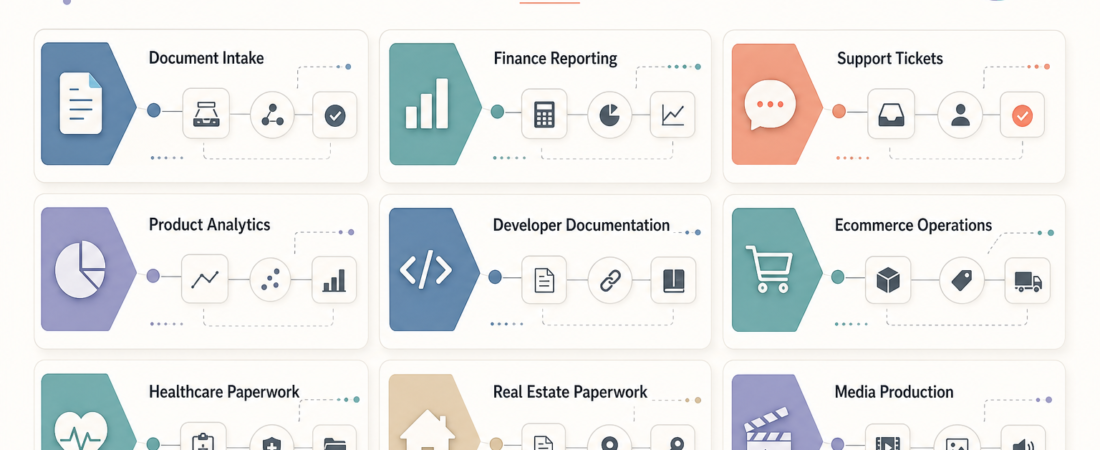
The current ASE industry map covers nine public collections: media and publishing, finance and filings, ecommerce and retail operations, legal ops and compliance, healthcare documentation and intake, product analytics and growth ops, DevRel and API documentation, customer support and success, and real estate workflows. Some are stronger and broader than others. That is intentional. A narrow collection with honest boundaries is more useful than a bloated one that hides uncertainty.
Media and publishing systems
Media & Publishing Systems is one of the clearest fits because the work is documentable and evidence-rich. The operating pattern is simple: ingest audio or video, produce transcripts, align subtitles, normalize quality, summarize the result, and prepare publish-ready assets.
Start with transcription and alignment. Faster Whisper High Performance Speech Transcription and WhisperX Speech Recognition, Timestamps, and Diarization help convert raw speech into time-aware text. From there, subtitle tools such as ffsubsync Subtitle Synchronization Tool fit the final-mile cleanup work that human editors otherwise repeat manually.
Best for: podcasts, lessons, interviews, internal enablement videos, and transcript-first publishing. Not for: rights management, editorial policy decisions, or automated publication without review. Starter workflow: transcribe an episode, generate chapters, align subtitles, normalize loudness, and hand the package to an editor with the transcript and timing evidence attached.
Finance and filings
Finance & Filings is useful when the task is grounded in records: invoices, SEC filings, billing exports, usage events, or reconciliation tables. The key boundary is that agents should help gather, normalize, and explain evidence. They should not invent accounting treatment or make investment recommendations.
A practical stack might combine SEC EDGAR Financial Filing Parser for research, Extract Invoice Fields From Vendor PDFs Into Structured Records for intake, and OpenMeter Usage Metering and Billing Platform for usage-based reporting. For revenue operations, Stripe-oriented skills can support reporting, webhook verification, and reconciliation when the agent has explicit read/write limits.
Best for: filing research, invoice intake, usage metering, billing QA, and reconciliation prep. Not for: tax advice, audit sign-off, investment calls, or unsupervised money movement. Starter workflow: collect the filing or invoice set, extract fields into structured records, compare against the system of record, and produce a review table with source links for every claim.
Ecommerce and retail operations
Ecommerce & Retail Operations is strongest around catalog and storefront operations: product data cleanup, inventory sync, order context, payment flow checks, and marketplace support. These are repetitive jobs where the agent can work from APIs and return concrete diffs.
The collection includes platform-specific and composable pieces: Shopify Admin GraphQL Sync Agent, WooCommerce REST Inventory Sync, and Saleor Open Source Headless Commerce GraphQL API. A team can use those with payment and webhook skills to inspect a broken order flow without turning the agent loose on production blindly.
Best for: catalog hygiene, inventory checks, order context, storefront QA, and payment workflow inspection. Not for: autonomous discounting, merchandising strategy, or fraud decisions. Starter workflow: pull a product set, normalize missing fields, compare inventory counts, check webhooks, and return a change proposal for human approval.
Legal ops and compliance
Legal Ops & Compliance is useful precisely because it is bounded. The collection is not legal advice. It is document work: OCR, search, clause extraction, archive lookup, redaction, signature routing, and evidence notes.
Several reusable skills show the pattern well: OCRmyPDF Searchable PDF OCR Pipeline, Apache Tika Document Extractor, LangExtract LLM Structured Text Extraction, and Redact PII From Text Before Sharing or Indexing With Scrubadub. Signature tools such as DocuSeal Document Signing PDF Forms can sit at the routing layer once the packet is ready.
Best for: contract packet prep, compliance evidence gathering, document search, and privacy cleanup. Not for: legal conclusions, negotiation strategy, or privilege decisions. Starter workflow: OCR the files, extract requested fields, search the archive for related documents, redact sensitive text for sharing, and produce a source-linked review packet.
Healthcare documentation and intake
Healthcare Documentation & Intake must stay narrower than the hype cycle wants. The useful work is paperwork-heavy: forms, scanned documents, transcripts, structured extraction, literature lookup, and privacy-aware routing. Clinical claims need a much higher bar than a marketplace collection can imply.
Useful skills include PubMed Literature Mining Agent, Expose FHIR Healthcare Data Resources to MCP Agents With Review Boundaries, OCR and PDF extraction tools, and redaction workflows. The point is to make intake and review cleaner, not to turn an agent into a clinician.
Best for: documentation intake, literature support, form extraction, and review packet preparation. Not for: diagnosis, treatment advice, triage, or clinical decision-making. Starter workflow: collect intake documents, OCR them, extract structured fields, flag missing information, and route the packet for qualified review.
Product analytics and growth ops
Product Analytics & Growth Ops is a strong fit because product teams already work in loops: define a rollout, observe behavior, inspect sessions, compare metrics, and decide whether to expand or roll back. Agent skills can keep those loops disciplined.
Start with PostHog Product Analytics and Feature Flags SDK, Flagsmith Feature Flag Remote Config, OpenReplay Self-Hosted Session Replay Analytics, and analytics tools such as Plausible Analytics Privacy-First Web Analytics. The agent can prepare a launch-readiness view, but the team should still own the decision.
Best for: release checks, experiment evidence, feature flag review, and session replay triage. Not for: growth strategy by autopilot or unsupervised rollout expansion. Starter workflow: verify flag targeting, capture baseline metrics, inspect representative sessions, run smoke checks, and summarize whether the release has enough evidence to proceed.
DevRel and API documentation
DevRel & API Documentation is one of the most agent-native collections because docs drift constantly. Specs change, SDKs regenerate, examples go stale, and broken links quietly erode trust.
The starter stack is straightforward: Redocly CLI OpenAPI Linter Documentation Generator, Spectral OpenAPI AsyncAPI Linter, Orval OpenAPI Client Regeneration Skill Typed SDKs, and Verify Markdown Links Before Docs or Content Ship With Markdown Link Check. These skills can turn docs work into a repeatable pre-ship gate.
Best for: OpenAPI linting, docs-site generation, SDK sync, link checking, and developer enablement. Not for: product positioning, support policy, or migration promises the product team has not approved. Starter workflow: lint the API spec, regenerate typed clients, update docs examples, check links, and return a diff plus validation log.
Customer support and success
Customer Support & Success works when it respects three systems of record: tickets, customer context, and the knowledge base. A good agent should gather those inputs before drafting anything customer-facing.
The collection includes helpdesk and knowledge tools such as Zammad Open Source Helpdesk Ticketing System, Chatwoot Open Source Customer Engagement Omnichannel Support, Search Help Scout Conversations and Thread Context Before Drafting Support Replies, and Outline Knowledge Base Wiki. CRM and contact-normalization skills can fill the context gaps that make support drafts brittle.
Best for: ticket triage, conversation summaries, KB lookup, account context, and draft replies. Not for: policy exceptions, refunds, cancellations, or sensitive account actions without approval. Starter workflow: classify the ticket, retrieve related threads, look up the KB answer, enrich customer context, draft a reply, and mark anything that needs escalation.
Real estate workflows
Real Estate Workflows should be read as an operations collection, not a promise of automated brokerage. The useful work is paperwork, contacts, document intake, property research support, and follow-up. Valuation, legal interpretation, and client recommendations need explicit human ownership.
The practical stack overlaps with legal and support operations: Paperless-ngx Document OCR Archive Management System, pdfplumber Python PDF Text Table Extraction, HubSpot CRM Contact Enrichment Pipeline, and RAG-Backed Real Estate Property Research. The value is in organizing messy transaction work, not pretending to replace licensed expertise.
Best for: transaction packets, document search, CRM enrichment, address research, and follow-up tracking. Not for: MLS completeness, valuation accuracy, legal advice, or buyer/seller recommendations. Starter workflow: collect property and transaction documents, extract dates and obligations, enrich contact records, and produce a follow-up checklist for the responsible person.
What the strongest collections have in common
The most useful industry collections share three traits. First, they have concrete inputs: PDFs, transcripts, tickets, API specs, analytics events, CRM records, or order data. Second, they have reviewable outputs: structured tables, diffs, summaries, validation logs, or packets with source links. Third, they include an escalation path for anything that crosses into judgment, policy, money movement, compliance, clinical review, or legal interpretation.
That is why the industry map is best understood as a set of starting points. Use Industry Collections to find the operating pattern, then open the individual skills to inspect sources, prerequisites, and trust signals. The right first workflow is usually modest: intake a document set, summarize a ticket queue, validate an API spec, inspect a launch, or reconcile a billing export. Once that loop is reliable, teams can add more skills around it.
Agent skills are already useful in vertical work, but the useful version is rarely magic. It is supervised automation around messy, repeated, evidence-heavy tasks. That is exactly where a marketplace should be opinionated: show the workflows that are ready now, keep the boundaries visible, and leave the final decision with the people responsible for the outcome.