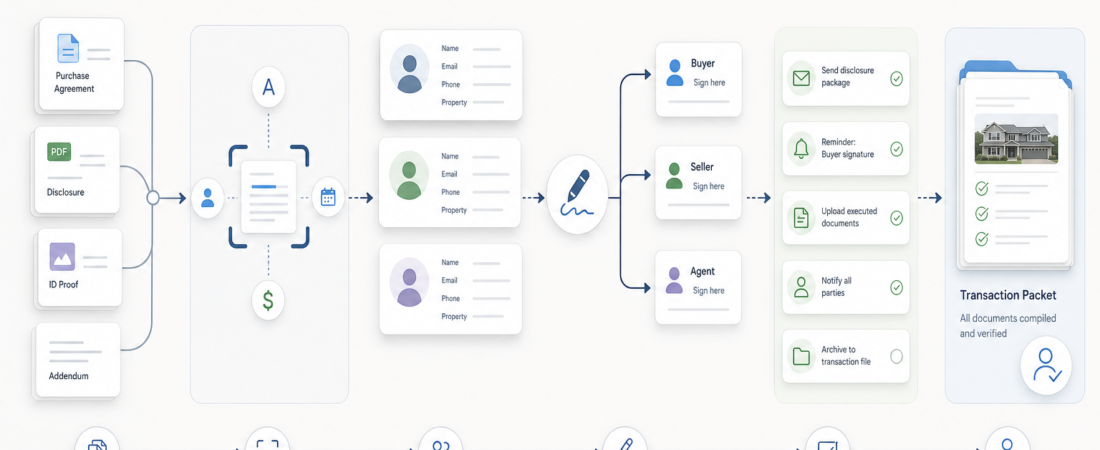
The Agent Skill Stack for Real Estate Operations Teams
Real estate operations teams do not need an agent that guesses a property value, writes legal advice, or pretends to know every MLS detail. They need a dependable assistant for the paperwork-heavy work that surrounds listings, transactions, leases, vendor coordination, and client follow-up. That means collecting documents, making them searchable, extracting the fields humans already review, keeping CRM records current, routing signatures, and preparing a clear packet before someone makes a decision.
| Workflow layer | Agent task | Human checkpoint |
|---|---|---|
| Document intake | Collect, OCR, classify, and extract fields from PDFs and forms | Confirm source documents and missing pages |
| CRM context | Normalize contacts, enrich records, and queue follow-ups | Approve updates before customer-facing action |
| Review packet | Summarize facts with links back to evidence | Decide, advise, negotiate, or escalate |
This is the practical lane for real estate AI: operations support, not autonomous brokerage. The right stack reduces file chaos, speeds up handoffs, and makes review easier without crossing into valuation accuracy, legal judgment, client recommendations, or claims about complete market coverage.
A safe real estate stack starts with boundaries
The first design choice is what the agent is allowed to do. A useful real estate operations agent can read a purchase packet, identify missing signatures, pull contact details from vCards, search a document archive, or prepare a follow-up list. It should not tell a buyer what to offer, represent legal meaning in a contract, guarantee MLS completeness, or recommend whether a client should proceed with a transaction.
That distinction matters because real estate work mixes ordinary coordination with high-stakes decisions. The same folder might contain harmless vendor invoices, client identity details, signed disclosures, inspection notes, financing documents, and attorney-reviewed language. Agents can help organize and cross-reference those materials, but the workflow needs checkpoints where a licensed professional, coordinator, broker, attorney, or client-facing teammate reviews the result.
In Agent Skill Exchange terms, this is why the Real Estate Workflows collection is framed as paperwork and operations support. The same boundary showed up in our earlier guide to real estate workflow skills: the goal is a repeatable operating model for intake, extraction, CRM context, signature routing, follow-up, and review packets.
Layer 1: collect and archive the paperwork
The first layer is document intake. Real estate teams receive paperwork through email, portals, scans, shared folders, and client uploads. If the agent cannot reliably find the current version of a document, every downstream step becomes suspect.
Paperless-ngx Document OCR and Archive Management System is a natural anchor for this layer. It gives the team a searchable document archive instead of scattered PDFs. For broker operations, property management, or transaction coordination, that archive can hold disclosures, leases, invoices, closing documents, inspection reports, and supporting correspondence.
When scanned documents arrive as flat images, OCRmyPDF Searchable PDF OCR Pipeline turns them into searchable PDFs. That sounds basic until a coordinator has to locate a clause, signer name, property address, or addendum across dozens of files. Searchability is the difference between an agent guessing from memory and an agent retrieving evidence.
Teams that receive mixed file types can add Search PDFs, Office files, ebooks, and archives with one query before manual review. In practice, this layer lets an operations agent answer narrow questions such as, “Which packet contains the latest signed seller disclosure?” or “Show every document mentioning this parcel ID,” while still handing the source files back for review.
Layer 2: extract fields without pretending extraction is judgment
Once documents are searchable, the next layer is structured extraction. Real estate teams repeatedly need the same fields: property address, parties, dates, contingencies, rent amount, expiration date, inspection deadline, signature status, invoice total, vendor name, and contact details. An agent can pull those into a spreadsheet, CRM note, task queue, or review packet.
pdfplumber Python PDF Text and Table Extraction Library is useful when the source document contains tables or layout-sensitive text. Inspection reports, rent rolls, fee tables, and closing statements often need table-aware extraction rather than a plain-text dump.
For more flexible entity extraction, LangExtract LLM-Powered Structured Text Extraction helps turn messy document text into structured fields. The important constraint is that extraction is not interpretation. The output should say where the field came from, whether it was missing or ambiguous, and what document page or section supports it.
That source link habit keeps the workflow honest. If an agent extracts a closing date, the packet should include the underlying document reference. If a deadline is missing, the output should say “not found,” not invent a date from context.
Layer 3: route signatures and forms
Signature routing is another high-value, bounded workflow. Many real estate operations delays are not strategic problems; they are missing initials, outdated forms, unsigned addenda, or a client who never received the latest packet.
DocuSeal Open Source Document Signing and PDF Form Platform fits here because it supports document signing and PDF form workflows. An agent can prepare the routing checklist, identify which documents appear unsigned, and draft the signing packet handoff. A human should still confirm the document set, signer order, and legal sufficiency before anything is sent.
The best pattern is simple: agent prepares, human approves, system routes, agent monitors status. That gives teams speed without allowing the agent to decide which legal document belongs in a transaction or whether a client has satisfied a contractual obligation.
Layer 4: keep CRM and contacts clean
Real estate work is relationship work, but CRM data often decays quickly. Contacts arrive from open houses, referrals, email signatures, buyer intake forms, vendor introductions, property management requests, and old exports. A real estate operations stack needs to normalize that context before follow-up tasks are assigned.
HubSpot CRM Contact Enrichment Pipeline can help enrich and prepare CRM contact context. For teams using an open-source CRM model, Twenty Open Source CRM Platform and Salesforce Alternative gives agents a structured customer record to work against.
Contact imports are another overlooked source of operational drag. Normalize vCard contact exports into structured contact records before CRM imports or dedup jobs helps turn address-book chaos into cleaner data before it enters a CRM. For a real estate team, that can mean fewer duplicate contacts, cleaner phone numbers, better company fields, and more reliable follow-up queues.
The checkpoint is again important. Agents can propose CRM updates and draft follow-up tasks, but they should not silently overwrite customer records or send client-facing messages without approval.
Layer 5: research property context with caution
Property research is useful, but it is also where overclaiming becomes tempting. An agent can gather context about a property, compile public facts, organize comparable references, or prepare questions for a human reviewer. It should not present itself as a licensed valuation engine or imply complete market data coverage.
Research real estate properties with RAG-backed market analysis belongs in the stack when the task is source-backed research support. The safest output is a packet: source links, extracted facts, open questions, missing data, and notes that require human review.
That packet format keeps the workflow defensible. Instead of “this property is worth X,” the agent can produce “here are the documents and external references found, here are conflicting facts, here are the assumptions, and here are the items a licensed professional should review.”
Layer 6: prepare the review packet
The review packet is the main deliverable of a real estate operations agent. It should bring together the source documents, extracted fields, CRM context, signature status, follow-up tasks, and unresolved questions. It should also include confidence boundaries: what was found, what was not found, and what a human needs to decide.
A good packet might include seven sections: property and party identifiers, source documents reviewed, extracted dates and obligations, signature status, CRM updates proposed, follow-up messages drafted, and exceptions requiring review. That structure is more useful than a generic summary because every section maps to an operational decision.
The packet should preserve evidence links. If the agent flags a missing disclosure, the reviewer should see which checklist or document set triggered that flag. If it proposes a contact update, the reviewer should see the source email, vCard, form, or CRM field that supports it. If it drafts a follow-up, the reviewer should see the customer context and the knowledge source behind the language.
A practical starter workflow
For a small team, the first version does not need to automate everything. Start with one repeatable handoff: new transaction packet intake. The agent watches a folder or receives a batch of documents, runs OCR where needed, archives the files, extracts the key fields, checks signature status, creates a CRM update proposal, and produces a review packet.
The team then reviews the packet before anything client-facing happens. After that review, approved follow-ups can be sent through the normal CRM or task system. If the packet finds missing documents, the agent can draft the request, but a coordinator should approve the message.
That workflow is valuable because it reduces the amount of manual searching while preserving accountability. It also creates better operating data over time: which documents are commonly missing, which packet types cause delays, which CRM fields are unreliable, and where escalation rules should be tightened.
What should stay human
Some work should remain clearly outside the agent’s decision boundary. Legal advice, brokerage advice, valuation conclusions, negotiation strategy, client recommendations, and claims about full market coverage need human owners. Agents can prepare evidence, surface gaps, and draft questions. They should not make the decision sound settled when it is not.
This is not a weakness of the stack. It is what makes the stack usable. Real estate operations teams are not trying to replace accountability; they are trying to reduce avoidable administrative drag. The strongest agents make the paperwork easier to inspect, not easier to ignore.
The bottom line
The agent skill stack for real estate operations is a document-and-CRM workflow with review built in. Use Paperless-ngx and OCRmyPDF to make files findable, pdfplumber and LangExtract to extract reviewable fields, DocuSeal for signature workflows, and CRM/contact skills to keep follow-up grounded in current context.
The outcome is not an autonomous real estate advisor. It is a better operations desk: searchable records, cleaner handoffs, fewer missing details, and review packets that let people make decisions with evidence in front of them.