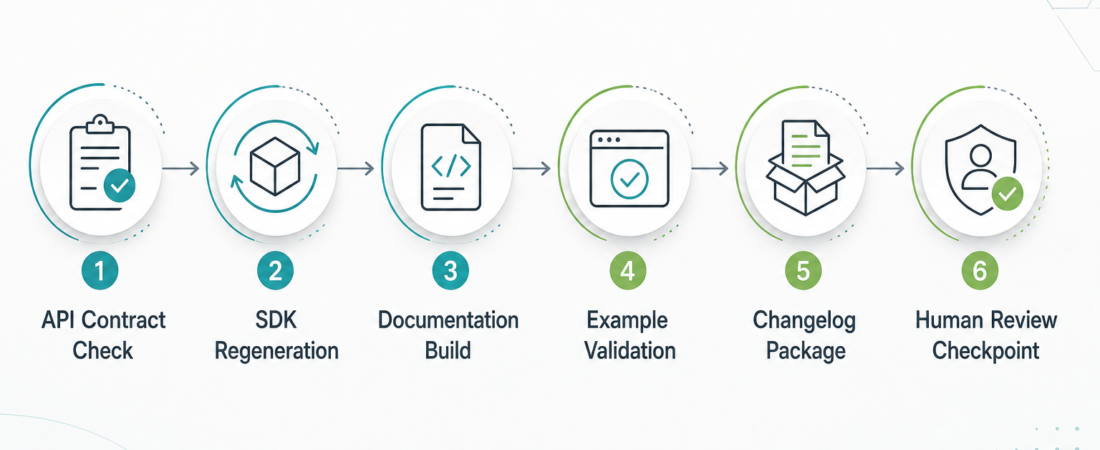
The Agent Skill Stack for Developer Relations Teams
Developer relations teams live at the point where product truth becomes developer trust. Every API change has to move through a chain of artifacts: the OpenAPI contract, generated clients, reference docs, quickstarts, code examples, migration notes, support context, and the changelog. When that chain drifts, developers notice fast.
| Release stage | Agent skill job | Human checkpoint |
|---|---|---|
| 1. Contract | Lint OpenAPI, detect breaking changes, and flag missing descriptions | Approve intentional API changes |
| 2. Clients | Regenerate SDKs and summarize typed API diffs | Review public interface changes |
| 3. Docs | Rebuild reference docs, quickstarts, examples, and style checks | Check clarity and developer intent |
| 4. Release | Prepare changelog notes, link evidence, and queue publication | Publish or hold the release packet |
The best DevRel agent is not a blog generator. It is a release assistant for developer trust. It checks whether the contract, SDKs, examples, and docs all describe the same product. It catches the quiet mistakes that make a developer lose an afternoon: an undocumented enum, a stale curl example, a generated client that no longer compiles, or a changelog that says “improved API behavior” without naming the behavior.
This playbook builds on the DevRel & API Documentation collection in Agent Skill Exchange. The stack is deliberately practical: start with the contract, regenerate the derived artifacts, verify examples, polish the prose, then hand a review packet to a human before anything public ships.
Start with the API contract
For API-first teams, the OpenAPI document is the most important DevRel artifact because so many other surfaces depend on it. Reference docs, SDK clients, mocks, examples, and support answers often inherit its shape. If the spec is wrong, everything downstream becomes confidently wrong.
A DevRel agent should begin by checking the contract before touching docs copy. Spectral OpenAPI and AsyncAPI Linter is useful for style and governance rules: missing operation descriptions, inconsistent naming, weak examples, unclear errors, and security-scheme gaps. Redocly CLI OpenAPI Linter and Documentation Generator fits teams that already use Redocly rules, bundling, and docs generation. For broader validation, OpenAPI Spec Linter & Docs Generator gives the agent a clear contract-checking stage before it starts generating artifacts.
The output should be a contract report, not a vague “looks good.” A useful report lists breaking changes, new endpoints, removed fields, renamed schemas, missing examples, undocumented auth behavior, and any rule violations that block publication. It should also separate intentional product changes from accidental drift. That distinction keeps the agent in the right role: evidence assembly, not release authority.
Regenerate clients from the same source of truth
Once the contract passes the first gate, SDK work should be generated from that same source of truth. This is where DevRel teams often accumulate subtle drift. A TypeScript client reflects yesterday’s spec, Python examples use a hand-written method name, and the docs site shows a response shape that no longer exists.
Orval OpenAPI Client Regeneration Skill for Typed SDKs is a good fit when the workflow needs typed clients from OpenAPI. Swagger Codegen Template Customizer belongs in teams that maintain custom generation templates for Java, TypeScript, Python, or other targets. If the API exists before the contract is clean, Bootstrap an OpenAPI spec from captured API traffic before client or test automation starts can help create a first-pass spec that humans can refine before generation becomes official.
The agent should commit to a repeatable SDK protocol: regenerate clients, run package tests, summarize public API diffs, and point reviewers to the exact generated files that changed. It should not silently rewrite templates or publish packages. Template changes are product-surface changes; they deserve a human review because they affect every developer who installs the SDK.
Build reference docs as an artifact, not a separate writing project
Reference documentation should be rebuilt from the checked contract whenever possible. That does not make human writing irrelevant. It gives writers a stable base so they can spend their time on explanations, migration guidance, examples, and product intent instead of manually copying response schemas.
Redoc OpenAPI Documentation Renderer and Scalar OpenAPI Reference and API Client Platform cover the public reference surface. MkDocs Project Documentation Generator is useful when the team maintains a broader docs site around guides, concepts, and tutorials. For React-based documentation sites, Fumadocs React Documentation Framework and Docs Site Generator can fit a modern app-docs workflow.
A good DevRel agent does not just run the docs build and declare victory. It should compare the changed reference pages against the API diff, identify pages that need narrative updates, and flag broken anchors or removed examples. This is where a release assistant becomes valuable: it notices when the generated reference changed but the quickstart, migration guide, or troubleshooting page did not.
Verify examples like production code
Examples are where developer trust is won or lost. A reference page can be technically accurate and still leave developers stuck if the curl command fails, the environment variable name is stale, or the TypeScript snippet uses a method that the generated client no longer exposes.
The agent should treat examples as testable artifacts. Pull every changed code block into a checkable inventory. Identify the language, required credentials, endpoint, expected response, and whether the example is safe to run in CI. For examples that cannot run automatically, require a reason and a manual review note. Link checks matter too: Verify Markdown links before docs or content ship with markdown-link-check is a simple but high-value guardrail before publication.
This stage should also feed support. If an example changed because an endpoint was renamed or an error response became stricter, the agent should prepare a short note for support and success teams. DevRel is not only documentation publishing; it is the connective tissue between product changes and the people who answer developer questions.
Run prose checks without sanding off judgment
Prose linting is useful when it catches inconsistent terminology, passive release notes, forbidden product claims, or accessibility issues. It becomes harmful when it flattens every explanation into generic copy. DevRel teams need both consistency and voice.
Vale Prose Linter for Technical Documentation gives an agent a concrete style-checking pass across Markdown, AsciiDoc, reStructuredText, and HTML. The agent can flag terms that violate the style guide, detect banned phrases, and identify headings that no longer match naming conventions. It can also produce a focused review list: “these five pages changed terminology,” “these three pages use deprecated product names,” and “this migration note needs a stronger warning.”
Keep the boundary clear. The agent can enforce the style guide and suggest edits. A human should make the final call on tone, positioning, and any customer-facing claims. That is especially important for API behavior, availability promises, pricing language, and migration risk.
Publish a changelog packet, not a loose note
The final DevRel deliverable should be a release packet. It can include the contract report, SDK diff summary, docs build result, example verification table, link-check output, prose-lint findings, and proposed changelog text. This packet gives engineering, product, support, and DevRel one shared view of what changed and what is ready to ship.
The changelog itself should be specific. Name endpoints, fields, SDK methods, deprecations, migration windows, and compatibility notes. Link to the relevant docs pages. If a change is breaking, say so plainly and point to the migration path. If a change only affects generated clients, identify which languages and versions are involved.
A useful agent can draft that changelog from evidence. It should not publish it without a checkpoint. The human reviewer should confirm that the packet matches product intent, that examples are safe, and that the support team has enough context for incoming questions.
A practical operating model
Start small. Put the first version of the stack behind one API release workflow. Run contract linting, regenerate one SDK, rebuild one docs surface, check links, and produce a review packet. Measure the bugs it catches: stale examples, missing descriptions, broken links, SDK compile failures, undocumented breaking changes, and support notes created before release instead of after developer complaints.
Then widen the loop. Add more SDKs, docs sections, style rules, and support handoffs once the team trusts the evidence. The goal is not to automate DevRel judgment away. The goal is to make every release easier to review because the tedious drift checks are already done and the evidence is in one place.
That is the right shape for DevRel agents. They are not here to manufacture more content. They are here to keep developer-facing truth aligned across contracts, clients, examples, docs, and changelogs so teams can ship with confidence and developers can build without guessing.